The Three Ideas We Never Compromised On


When we built our very first trailer in 2017, we weren't planning to start an RV company.
We simply wanted a trailer that fit the way we wanted to travel.
As architectural designers, we were surprised by what we found in the RV industry. Heavy trailers. Outdated construction methods. Insulation systems that often prioritized appearance over true performance.
Every new model seemed to offer more space, more features, and more equipment, but rarely a better design.
So we built our own.
That first prototype wasn't intended for customers. It was built for ourselves.
Two years later, in 2019, we officially launched Polydrops, a company built around designing polygonal teardrop trailers that prioritize efficiency, simplicity, and thoughtful engineering.
Since then, through every redesign and every new model, three ideas have never changed.
1. Energy Independence Was Never Optional
Long before solar became a standard feature, we believed every trailer should generate and store its own energy.
Not because bigger battery specifications looked better on a brochure.
Because relying less on external infrastructure makes travel simpler.
From the beginning, Polydrops included both solar and battery storage as standard equipment.
To us, that wasn't a premium feature.
It was simply how a modern travel trailer should work.
2. Insulation Is Not an Upgrade
A comfortable trailer isn't created by installing a larger air conditioner or a more powerful heater.
Comfort begins with reducing unwanted heat transfer in the first place.
Good insulation keeps interiors cooler in summer, warmer in winter, reduces energy consumption, and creates a quieter living space.
From the beginning, we also questioned what "fully insulated" should actually mean.
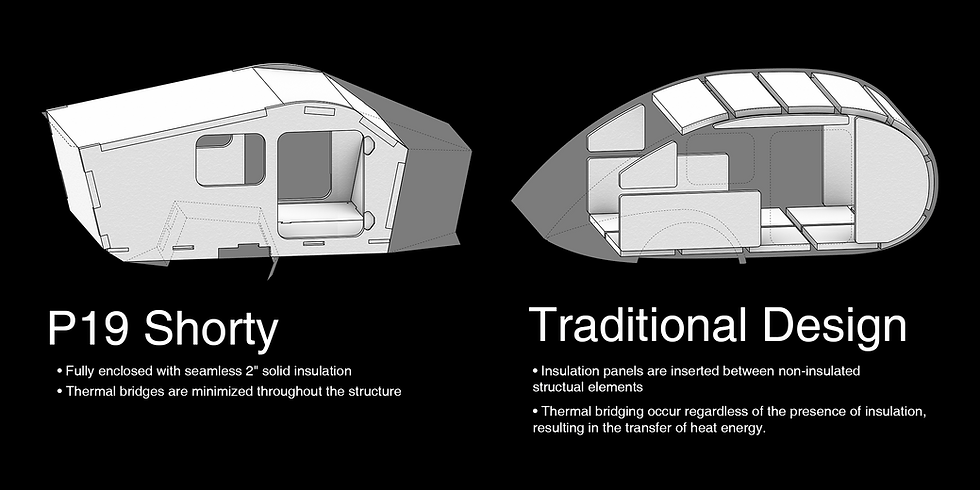
Many traditional trailers place insulation between structural members and consider the space insulated. However, the structure itself can still create thermal bridges, paths where heat and cold can transfer through the frame, reducing overall thermal performance.
To us, true insulation means designing the entire structure to minimize thermal bridging, not simply filling empty spaces with insulation material.
As architectural designers, we viewed insulation as part of the architecture, not an accessory.
That's why proper insulation has been one of our core design principles since the very beginning.

3. Efficiency Before Everything
The easiest way to add features is to make a trailer bigger.
The harder challenge is making it better without making it larger, heavier, or more complicated.
Every design decision affects efficiency.
Weight.
Aerodynamics.
Thermal performance.
Energy consumption.
These are not independent choices. They are all connected.
Rather than asking:
"How much energy can we carry?"
We've always asked a different question:
"How can we reduce the energy that is wasted?"
That philosophy influences everything we design, from insulation and materials to shape and overall packaging.
Principles Outlast Products
Over the past several years, the RV industry has changed.
Battery capacities have increased.
Solar panels have become more affordable.
Electric vehicles have become more popular.
Many products have followed these trends.
Our principles haven't.
Technology will continue to evolve.
The products we build will continue to evolve.
But we believe good design begins with principles that don't change.
These three ideas have guided every trailer we've built since 2017.
And they'll continue to guide every trailer we build in the future.


